
The Step Up Story
This is the story of a rather odd tech startup.
Step Up is part of the Future Companion Technologies (FCT) ecosystem
Future Companion Technologies (FCT) is a Hong Kong company and the holding company of our group. Step Up Education JSC is FCT's operating company in Vietnam: we make and run Robot Pika, The Coach app and other English learning products for Vietnamese learners.
FCT works with partners outside Vietnam: distributors, retailers, schools, companies and technology partners.
Step Up Education – 25/6/2024
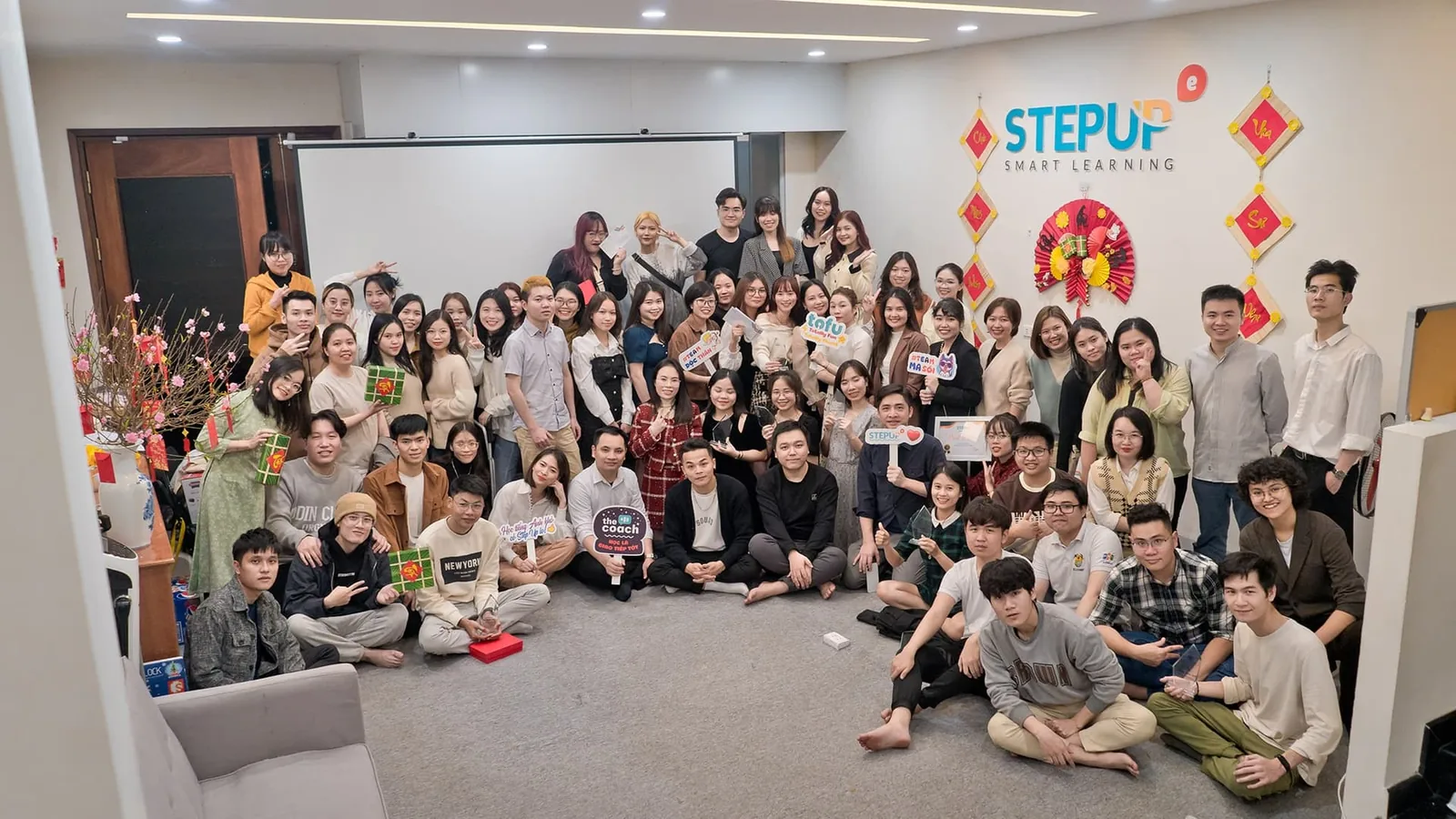
This is the story of a rather odd tech startup. The founder wasn't a tech person: he worked in publishing before switching fully to EdTech. Through a lot of blood, sweat and tears, that startup turned a profit on its English learning app in under 2 years, and the app regularly tops the spoken English apps in the Vietnamese market. As for the experience and the features, what customers say in their honest reviews doesn't lie.
I'm not telling this story to inspire anyone or to show off. I want people who care about Step Up to understand more about what we've done, what we want to do and what we will do. I hope to meet hearts and minds with the same aspirations, people who also love solving this problem and want to come along in different roles: on the payroll, as partners, as investors… There are many hard problems to solve and many difficulties ahead that call for grit and long-term vision. We can only go the distance together if we understand each other.
Why education?
Leaving other aspects aside, look at Israel: a country poor in natural resources, yet always a powerhouse in technology, agriculture, defense… Education is a magical thing that can turn a buffalo boy from the countryside into a senior leader at the world's top tech companies. Invested wisely, it always sits at the very top of the highest-return investments for every family and every nation, and its impact lasts a hundred years.
Beyond its human value, education has always been a promising business. The education market has been growing at a storming pace lately, and it is less affected by economic downturns than other industries.
An IT worker earning 1,000 dollars a month who gets fully upskilled in their craft, in English and in working with foreign colleagues can easily take home over 100,000 dollars a year. Over a 40-year career, that difference adds up to several million dollars. What investment other than education has an ROI that big?
What's more, Vietnam and Southeast Asia as a whole will soon become a hotspot for developing high-quality talent. The EdTech market in the region is expected to double over the next 5 years.
For decades, learning hasn't had a truly big revolution the way other industries have. Learning is still basically boring and not tailored to each person. We were born to fix this. Step Up hopes that 20 years from now, there will be a fresh, capable generation of young Vietnamese who are true global citizens.
About the mission.
There's the story of the elephant's chain. They say that however big an elephant grows, you only need to chain it when it's young. For the rest of its life it believes that no matter how hard it struggles, it can never break that chain. What if children born in Vietnam today still believe, 30 years from now, that to do something big and compete globally, you first have to study at one of the world's top universities?
I believe something different. With enough will and hunger, a completely self-taught young person can build products that compete head to head with world-class products made by Ivy League graduates. Being able to teach yourself anything is a superpower, and the biggest competitive advantage there is. The internet age has made knowledge almost free, and the AI age will make it far easier to absorb. Knowledge and AI models are no longer privileges reserved for the elite.
The Coach's competitors in English learning are usually companies that have raised hundreds of billions of dong, with teams boasting shiny profiles. Step Up's founder didn't come from tech and graduated from Foreign Trade University, a school outside the world's top 1000. The Coach's funding is also completely homegrown, our own money. After a whole year of The Coach standing firmly at number 1 in this category in Vietnam, I believe even more in the ideas above. This story doesn't end here, and it won't stop at Vietnam's borders.
Back in the days of Uncle Ho and General Giap, Vietnam also had its stories of going toe to toe with the world's top 5 nations. There's no reason later generations can't do the same in the economy.
I believe in a dream where even poor children in the most remote areas get access to world-class education and build products that change the world for the better. A young generation that is happy, talented and well-rounded. Kids holding Vietnamese passports who can go out and stand shoulder to shoulder with peers from every continent.
If you share a dream like this, even if you're already in business or want to start up in this field, don't hesitate to connect and talk with Step Up. As the Vietnamese saying goes, one tree alone can't make a mountain. Three trees together make… a nice little rock garden 😀
What is Step Up about?
Step Up is an 11-year dream. An obsession
2011 was the year I graduated. With countless paths in front of me, I had nothing to lose anyway, plus a few words of encouragement from business owners I knew. So off I went. That's where the startup journey began. English was the tool that opened up all the education on the internet to me.
What name stands for progress? Ah, Step Up. One step at a time, all the way up.
From a tiny 12-square-meter classroom rented by the session, we grew into a chain of 4 centers with 60 teachers. Then we moved into books, starting with 5 staff, and took off to become a leading title in vocabulary books and English learning in general. Hundreds of thousands of readers have become far better at English thanks to those books. But a book still can't talk back to a learner and give them confidence, so Step Up reinvented itself once again, moving into EdTech with The Coach. Throughout that journey, the dream has always been to bring English to everyone with an experience that is fun and affordable, and on top of that, really fast. “Easy, Fun, Fast” has been the Step Up motto for more than a decade. Spoken English shouldn't be only for rich kids and the naturally gifted. It should be something everyone can have and reach at a low cost. With technology, learning English has changed a lot compared to 5 years ago. With smart, effective methods, we hope to help millions of Vietnamese people speak English with confidence for just a few million dong.
The founder's backstory
Back when I was 18, I got into my dream university. Only then did I realize that my dream was a backup option for lots of other smart kids. For some of them, if they couldn't study abroad at a school they liked, they'd go to Foreign Trade University. For me, studying abroad wasn't even on the table. That's where my FOMO and extreme competitiveness came from. I always wanted what I learned and what I could do to be every bit as good as what students at the world's top universities could.
Somewhat obsessively, since I couldn't go abroad to study, I hunted down every program and every bit of course material from the world's top universities and studied them myself, from bachelor's level all the way to MBA. Luckily the world is flat and education on the internet is free, enough for anyone to become whoever they want to be. The problem Step Up wants to solve is to help create global citizens with the full set of skills young people need to conquer any mountain and work anywhere in the world. Then they can bring that knowledge home and give back to the country. English is the starting point.
Step Up before the app
Steering Step Up from publishing fully into tech was 20% courage, 80% foolishness. Honestly, when I pressed the button back then, my thinking was pretty simple. Only once I'd picked up the spear and had to see the fight through did I realize how heavy the problem really was and how hard it was to solve. Believing I could pull it off was still a bit blind. In business and investing, letting the chickens out only to chase them around the yard is truly foolish. Unless the stars line up perfectly, you're lucky, you can grit it out like a champion, and the payoff is worth the risk you took.
Time is not on our side.
Tech companies usually burn cash for 4-5 years before they turn cash-flow positive. Few founders have pockets deep enough to carry a team like that, so raising money is almost a given for a tech startup. Even at our company, where the tech and product team is lean and tiny, it's still over 20 people. If I chose to raise money, I'd have to give up 50% of my time to meetings and pitches, with no time left to build the product. And getting money is hard, generally speaking. To be honest, the folks in offline education are very rich, some with hundreds or even thousands of billions of dong, but EdTech players in general are losing money hand over fist, with no shore in sight.
I chose what was, for me, the easier option: betting my own money, and giving everything no more than about 2 years to break even. This is a pressure cooker on the highest flame, folks. Basically, some projects don't get 3 months and a 2 billion dong budget; they get 1 month and 500 million. Put simply, slow means dead. More than a decade of work, investment and savings would go up in smoke. The upside: once you're profitable, raising money for growth is very easy, and I still keep most of the company's shares. Honestly, I was a bit led astray by Elon Musk and the way he built SpaceX. The all-or-nothing road is far more suffocating than playing with other people's money.
Step Up's execution story
Step Up's board believes flowery marketing is easy: it's not hard to find someone who can tell a good story. 50 years from now, the companies that are great at execution and engineering won't lose to anyone.
Honestly, I have two great teachers. One quit a cushy job as vice president of an investment fund to ride the internet wave. With no proprietary technology at all, purely through execution, he built the Amazon empire that now covers a good chunk of the sky. The second teacher is a scrap dealer: with only enough money to buy a few rockets, he changed how humanity goes to space, with technology even better than NASA's. A teacher who is brilliant at engineering and hacking things, and at building enormous things on a small budget.
The China mentality The 21st century may well be the Chinese century, with huge leaps in the economy, science and technology. But their starting mindset is to make the easy things first, cheaply, and worry about inventing new things later. When I threw myself into tech, I knew this game demands a lot of effort on many different pieces of software. AI here, infrastructure there, ERP somewhere else… There is far too much to build, and a homegrown budget is never enough to buy everything at list price. So for the company to survive, nearly every piece of software the team builds has to cost as little as possible. I'm quite proud of how deeply that mindset has sunk in. For example, when the office floor broke, I got a quote of 19 million dong, and the team popped next door and hired another crew to do it for 12 million. :D Clearly, I'm in good hands. From the day I set out on this road, I accepted a scenario where nobody would give me money for this gamble. In reality it's almost exactly that: plenty of investors are interested, but very few actually put money in. If I went all in on fundraising, there would be almost no time left to do the work. I come from a traditional business background, and my thinking on competitive advantage is pretty simple. With the same features, price is the strongest weapon. A company that spends only a few million dollars to build something can, in the long run, price it at maybe 50% of a competitor that spent 10-20 million dollars. This fundraising winter is the era of the “cockroaches”. A cockroach is what we call a small, lean, unkillable company: you chase it forever and it never dies.
Hacking the timeline At one of our strategy meetings, everyone on the core team had to write down the company's competitive advantages. Some of them wrote “Henry” on their sheets. Life pushed me around and resources were limited, so I had to become someone who could solve lots of problems across many different fields, or the company would never have survived and grown to where it is today. For big projects measured in months, I break them down on a Gantt chart and lay them out on the table like kids playing shop. Every item gets an A, B, C or D priority. Whatever is the bottleneck of the whole project and can be hacked, we find a hack for it. Whatever can run in parallel with no dependencies, we run in parallel.
A feature we ship in one month takes a competitor 7 months. So it might take them 2 years to build what we had by month 7. Then what will things look like in 5 years? Speed also comes from being generalists. Step Up's board and managers each need to carry 2-3 sets of know-how across R&D, Tech, Marketing and Sales, so deciding on features and shipping them is very fast. Little time is lost translating between teams and getting on the same page. If you search for The Coach on Facebook, you'll find that the person who has written the most posts about the app is our tech lead, not marketing. Being multi-skilled is a culture that lets everyone grasp the problem and solve it far better than separate silos ever could.
A product made by someone who taught themselves English, someone who writes funny content, a former teacher, a salesperson… turns out different from a product made only by people who know tech. They ask sharp questions and dislike well-worn paths. Step Up doesn't ask how to grow revenue at any cost so we can raise money and keep playing. Step Up's question is how to make a lot of profit while growing features and revenue at lightning speed.
Step Up's work culture
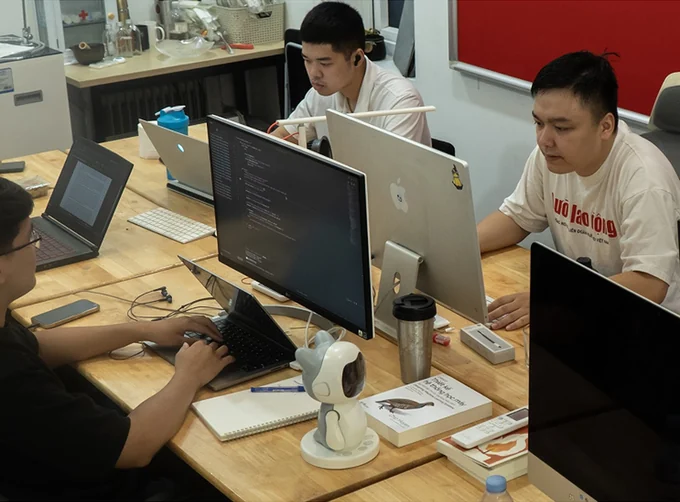
Be ambitious at work
Each of us has more in life than work: family and relationships. But you have to be well-off and good at what you do to support a family, right? Students start out equally clueless, yet 5 years after graduation some will have raised their pay by 20%, and others to 20 times their starting salary. The difference is the effort to keep learning, to hack your brain for work, and to push a little harder every day. At work, find the best person, inside or outside the company, at whatever you're learning, and stick with them. Be determined and take initiative.
Learn proactively, never stop learning
Employees are allowed not to know parts of their job, or to lack some skills and knowledge. But you have to fix that by digging in until you do know. Don't just fill knowledge gaps: proactively learn more about your craft, and surprise your bosses beyond their expectations with what you know and can do. Step Up values people who are eager to learn and ambitious at work.
Once upon a time there was an English teacher who, one day, on a whim, started a business in something completely unrelated to his field: technology. Twenty years later, that company was one of the top powers in global e-commerce. The company is called Alibaba and the 40 Thieves. The teacher is Jack Ma. See, where you start doesn't matter that much. What matters is wanting to be good, daring to act and having the discipline to keep going.
Set high standards
Never be satisfied with your current product or results. Benchmark every task and product you work on. Read and learn a lot to raise your taste. Ask yourself: is this world-class yet? Could I do it 3-5 times better than now, and how would I get there? Set yourself challenging goals. Only by taking on challenges do you hack your own limits, end up with good stories to tell, and find life full of new and meaningful things.
Find a way to get it done
If a task is beyond your skills and knowledge, research it first: plenty of people out there have already solved similar problems. Don't be shy about asking your manager, or your manager's manager, either. Do whatever it takes until you have a solution. Be upfront about the difficulties and the problems.
Mistakes are allowed, and fixed across the whole system
As the Vietnamese saying goes: got it wrong, fix it; got pregnant, have the baby. No big deal. Employees are allowed to make a mistake the first time. Fix it in the process and tell the whole system about it, so nobody makes it again.
Democratization and digitization
For the company to grow, it needs lots of talented people. And talented people usually aren't the obedient type, and they love to push back. Bosses and employees debating a topic is completely normal. Employees have the right to defend their views instead of blindly following whatever the boss imposes. The boss can be wrong, but the organization has to be right. Use numbers to measure results: whatever works better, do that. If you can do it more effectively than your manager, go ahead and do it your way, no need to follow your manager's instructions. But if not, follow the direction and open every sense you have to learn.
Pull together for the company
We're a young, fast-growing company, so lots of things are still rough around the edges. The board will inevitably make some policies and decisions that not everyone likes. We ask for your understanding: give the company feedback, and even better, bring a solution :D.
Throw yourself into the shared work of the organization. The company gets better faster when initiative and effort come from many sides and many people. Think and work like you own the company.
Work smart
The company's general view is to work smart: you only need 8 hours a day, but make them truly productive so they produce one and a half or two times the results. For your daily work, or tasks your boss hands you, always look for ways to cut manual steps and processing time while keeping the result just as good, or even better. Don't just work hard, work smart.
Work hard
At a startup, busy stretches are unavoidable. If we need overtime or extra hours for a certain period, please bear with each other. If it happens regularly, the company will hire more people.
Honesty
No lying, no dodging. When you get something wrong, own it: don't blame others, and don't steer the conversation away from the problem. Step Up does not accept employees who go against this value.
Pay that matches your worth
Building an excellent working system with high incomes is the company's direction. That is Step Up's people philosophy. If employees are paid below their market value, sooner or later they'll want to leave. The company wants to keep talented people and is ready to pay them what they're worth. But first, prove your value to Step Up.
Everyone should be different
Stay calm when you see that others differ from you in lifestyle or appearance. Everyone is different and SHOULD be different. Treat people based on who they really are, not on how they differ from you.
Overall, Step Up is a wholesome place to work. An education company should be well-mannered and healthy. No cliques, no discrimination, no toxicity, no cheating or lying. A team whose biggest concern is the product and the results of the work.
If you share our dream for education, love solving hard problems and like the way we work, apply to join the Step Up team now!